

Frans Masereel
Blankenberghe/Belgien
1889 -
Avignon
1972
The painter and graphic artist Frans Masereel was born in the Belgian town of Blankenberghe in 1889. In 1896 he moved to Gent, where he began to study art at the "Ecole des Beaux-Arts" in the class of Jean Delvin at the age of 18. In 1909 he travelled to England and Germany, where he was inspired to create his first etchings and woodcuts.
From 1911 Frans Masereel settled in Paris for four years and then emigrated to Switzerland, where he worked as a graphic artist for various journals and magazines. His woodcut series, which were mainly of sociocritical content and of expressionistic formal concept, gave Frans Masereel international acclaim. Among them were his so-called image novels including "Passion eines Menschen", "Mein Stundenbuch", "Die Sonne", "Die Idee" and "Geschichte ohne Worte", which all date from around 1920. At that time Frans Masereel also drew illustrations for famous works of world literature by Thomas Mann, Emile Zola and Stefan Zweig.
In 1921 the artist returned to Paris, where he created his famous street scenes, the Montmartre paintings. From 1925 Frans Masereel lived near Boulogne-sur-Mer, where he painted predominantly coastal landscapes, harbor views and protraits of sailors and fishermen. During the 1930s the number of illustrated books and individual woodcuts decreased considerably.
In 1940 the artist fled from Paris and lived in several locations in Southern France. At the end of World War II, Frans Masereel was able to resume his artistic work, which had been lying idle for years. He created woodcuttings and paintings. From 1946 Masereel worked for several years as a techer at the "Centre des Métiers d'Art" in Saarbrücken. In 1949 he moved to Nice. In the following years until 1968 numerous woodcut series appeared, which differed from his earlier "novels in images" as they were no longer based on a continuous narrative but on variations of a subject.
He also designed decorations and costumes for several theater productions. Frans Masereel was honored with numerous exhibitions and became a member of several academies.
In 1972 Frans Masereel died in Avignon and was buried in Gent.

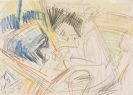
![Otto Mueller - Zwei Zigeunermädchen im Wohnraum [historischer Titel]](https://www.kettererkunst.de/still/kunst/picm/22/125000258.jpg)

Would you like to sell a work by Frans Masereel?
Infos for seller


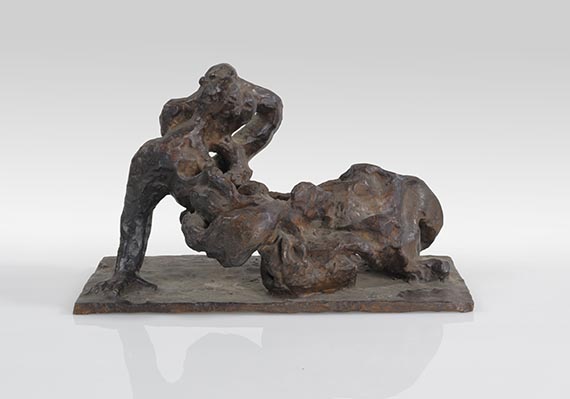
Starting bid: 4,500 EUR